Our new series of IHP Dispatches opens up our research and engagement processes by narrating the behind-the-scenes work involved in digging into the university’s history–from research trips to archival sifting, from engaging with people to building relationships–with stories told in the voices of the people doing that work. Read our first installment below.
A Dispatch from the Field
By Camron Michael Amin, Inclusive History Project Director of Research, UM-Dearborn and Professor of Middle East and Iranian Diaspora Studies, College of Arts, Sciences, and Letters, UM-Dearborn
In May 2025 I accompanied a research team to interview a former chancellor of the University of Michigan-Dearborn, Blenda J. Wilson. It had taken our research team a while to find her, but Jay Snyder-Phillippoff, a student intern with the Inclusive Storytelling Hub (ISH), had recently located her at a new retirement community in New Jersey near where she had grown up. After they first connected, Jay and Blenda began having “lots and lots of phone calls,” as Jay recalls now. What was astonishing to me was that until Jay connected with her, Blenda was “Chancellor Wilson,” the first African American woman to serve in that role (1988-1992) and the subject of a stunningly unique portrait by John Onye Lockard. She was someone I had only heard about and, suddenly, there was the prospect of getting to meet her.
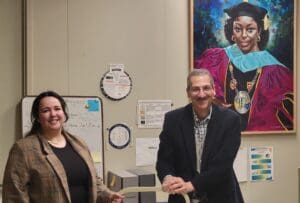
Marlaine Magewick and Cam Amin pose in front of a portrait of Chancellor Wilson in the UM-Dearborn Campus Archive, 2024. Courtesy of Heidi Keppen Palmer
Both Marlaine Magewick, our IHP Program Coordinator for Digital Humanities, and I have been captivated by Blenda’s portrait since we first toured Mardigian Library’s campus archive with Autumn Muir in early 2024. In that first viewing of the almost mythical portrayal of Blenda in her academic regalia (probably based on a photo of her speech at UM-Ann Arbor’s December commencement in 1989), we did not know that portrayal had a lot to do with Lockard’s philosophy. He intended for individuals to be seen as members of–symbols for–the community they belonged to. IHP co-chairs Earl Lewis and Liz Cole first encouraged us to develop a project around the portrait after they saw it on a tour of the Dearborn campus with the IHP Advisory Committee in May 2024. The initial idea was to explore finding a new and permanent place to display the painting, perhaps in coordination with an event or short-term exhibit. The interns of the Inclusive Storytelling Hub were tasked with exploring how to document that process.
Our research started with the portrait but expanded well past it, drawing on a growing circle of expertise. Under the supervision of Marlaine, and with the assistance of our UM-Dearborn Campus Archivist, Hannah Zmuda, IHP research assistants Wallace Bowie and Kandra Polatis had been digitally curating an interview Blenda had given in 2003 and had begun locating records of her time as chancellor; they also tracked down records of Lockard’s career at UM-Ann Arbor and Washtenaw Community College. In the meantime, ISH interns under the supervision of Rick Morrone of the Journalism and Media Production program had located lots of footage of Blenda–with some assistance from Greg Taylor, who found a recording of an amazing “retirement roast” Blenda did of her colleague, Provost Eugene Arden, in 1990. As the ISH team uncovered this compelling footage of her time as chancellor, the focus of the documentary began to broaden well beyond the portrait.
Even so, we had to know what Blenda thought of her portrait, since it had loomed so large for us for so long. Jay asked, and the answer reframed everything for us. Blenda had never seen it! How could that be? Of course, we had to go to New Jersey and show it to her–and film her reaction. We now had the makings of a well-researched documentary on the careers of two African American builders of U-M’s legacy, an administrator and an artist, both committed to building a better society through their talents. We could help tell that story.
But who was “we” going to be? Certainly Rick and Jay. It was also decided that the production value we sought needed the skills of another ISH intern, Jabez Williams. Who else? IHP Managing Director Jenni Brady encouraged me to go with the team. I was reluctant. All I saw was time I didn’t have and expertise I lacked. I could, however, drive people around and help with logistics on the ground. That did seem within the scope of my responsibilities as research director. And, maybe, Jenni nudged, a research director would be the right emissary from the IHP to a former chancellor. Okay, okay–I was going.
I sent the text of the email below to Jenni with the subject line “Trip Update” on May 13. This was after our flight to Newark was, to our genuine surprise, not late. (The headlines about the woes of that airport had almost driven us to cancel the trip.) It was after I got to see what dedicated, creative, and resourceful people Rick, Jay, and Jabez were as we shared meals, reviewed research, talked about (and listened to) music in a rented Caravan, and strategized over the interview process and camera angles. It was after we all got to know someone who helped shape the campus community we now shared. It was after the team had become my team and I could not wait to brag on them a bit.
Text:
Good evening,
Tomorrow we are just traveling home, so my brain can focus back on any reporting-related stuff when I’m able to peek at email. Tuesday and Weds have been very full. But absolutely amazing. So much footage! It’s taking overnight to back it up to the cloud.
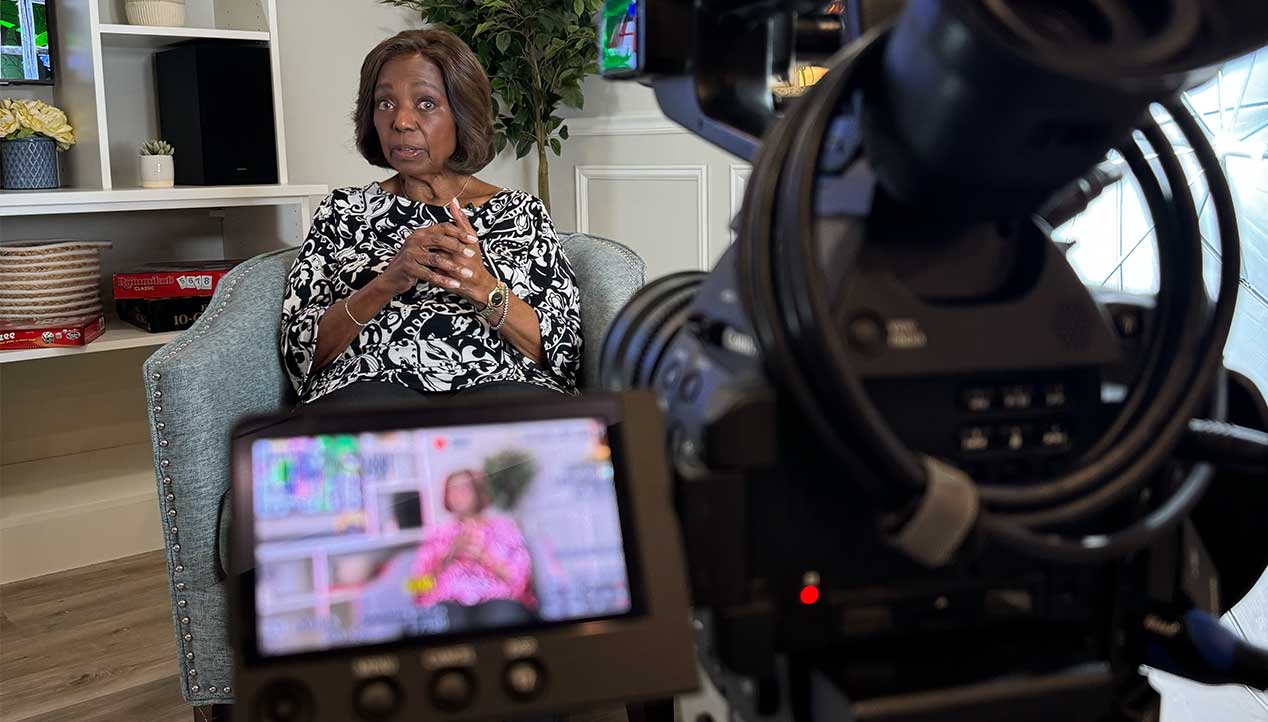
Blenda (which I learned is pronounced just like Glenda; of course it is–I’m an idiot) was generous and gracious for over an hour yesterday–and 8 hours today. Rick and Jabez were meticulous and creative and attentive to getting all the technical pieces to come together; but even they could not help but ask a (very good) question or two. Jay was an absolute star in the interviewing process.
Showing Blenda the portrait was rewarding and cool to film. But, that reaction was nothing compared to her response to the teaser from the Summit. You’ll never see a more delighted smile in your life. She was marveling at her younger self. And that was before noon.
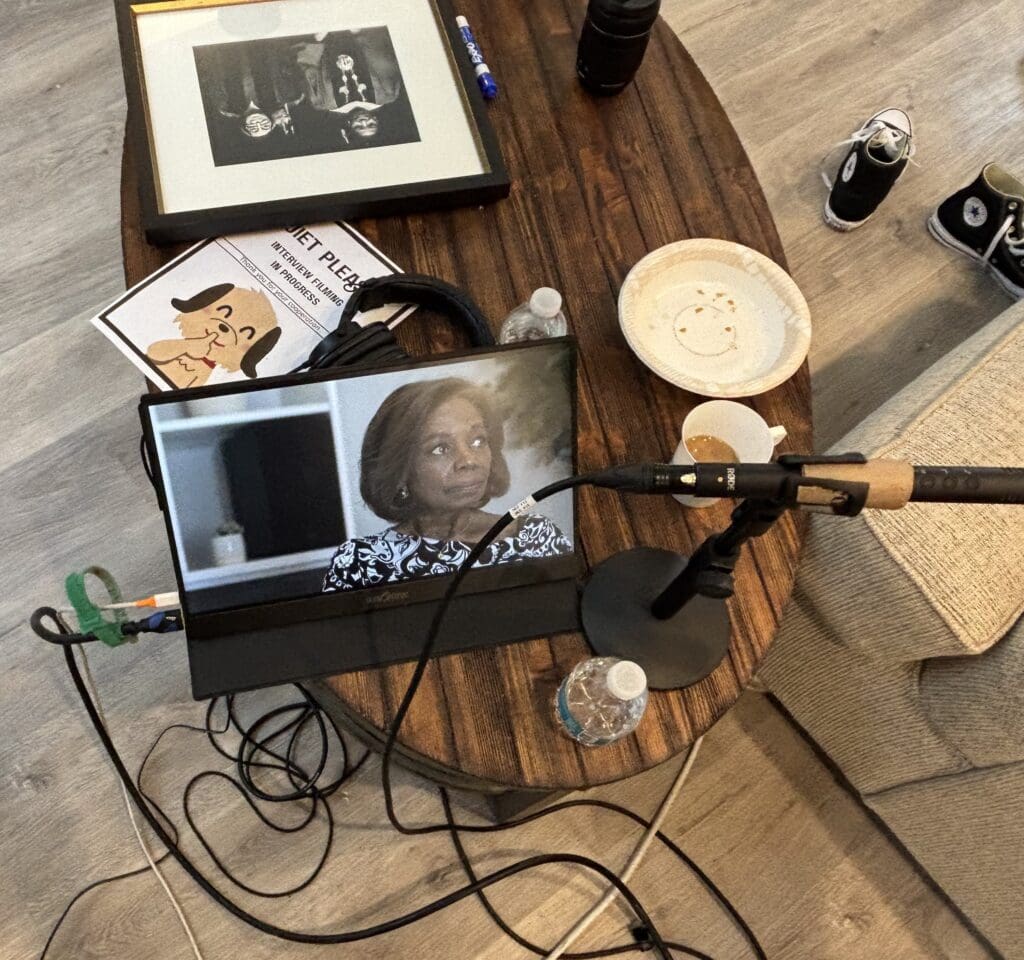
As we were setting up for the last segment, my eye caught a view of a coffee table still life. And I snapped a shot of it:
A boom mic, a monitor I was using to follow the session (with Blenda noticing something Jabez and Rick were doing off camera), Jay’s shoes, a copy of the “quiet please” sign they posted on the clubhouse door, a picture of Blenda and Rosa Parks from 1991 (unceremoniously laying there after its cameo in an [sic] earlier in the shoot), the water and tea we almost spilled because of the web of cables every damn place, headphones, a marker for the slate (“Blenda interview, scene 3, take 1” has to be written out, of course) and a paper bowl with a few cinnamon roll crumbs (Blenda arranged for us to have snacks and lunch on location).
Two hours later, it would all be cleaned up or packed up. Like it never happened. But it did. It’s all backing up to the cloud. It will rain down as history. It will soak into our collective memory as a documentary.
This was a pretty good day at the office.
Cam
Sent from my iPhone
Post Script
I reread this email recently, over three months after I sent it. What strikes me in retrospect, beyond my exuberance, is how much had to fall into place beforehand for that email to exist at all. I’m also thinking of how much work is still ahead for dozens of researchers before the documentary is screened in early 2026. They are mostly IHP-funded staff, students and faculty at UM-Dearborn, but also colleagues at UM-Ann Arbor.
How much of this history can we express in this one documentary? I don’t know if Blenda’s recollections of growing up often being the only African American person in a class or, later, in a boardroom will make the cut in the documentary. But it will be in her new oral history interview that we will preserve and make available in full. It will be in my fond memories of discussing everything she told us and showed us with Rick, Jay and Jabez–in the van and during the very long wait for our flight back to Detroit from Newark (but, amazingly, we got re-routed and were only a little bit late getting home). I don’t know if Blenda’s discussion of leaving a happy circumstance at Dearborn for a leadership opportunity at California State University-Northridge will make the cut. But the pull of that choice was that California had a system of higher education that more fully squared with Blenda’s values–values she cultivated and operationalized for years before arriving in Dearborn. She felt higher education should have many points of access and be accessible to all who sought it. Like many other leaders of the Dearborn campus, she had reason to believe that the Regents and Presidents in Ann Arbor would never fully value our campus as such an access point. And like any campus leader, her time as chancellor was not without its setbacks and controversies.
May 13, 2025, was not my first, or my last, “good day at the office” as IHP Research Director at Dearborn. Reflecting on that email reminds of all the reasons why.